

Precision Manufacturing: The Key to Lower Window Uw Values and Unrivaled Thermal Efficiency
Explore how advanced precision manufacturing techniques significantly lower window Uw values, delivering maximum thermal efficiency and energy savings for your home. Learn about Egelux's commitment.
Introduction: The Quest for Ultimate Thermal Efficiency
In the world of modern construction, windows are no longer just openings for light and views; they are critical components in a building's thermal envelope. Achieving maximum thermal efficiency is paramount for reducing energy consumption and creating comfortable indoor environments. At the heart of this efficiency lies the window's Uw value – a crucial metric that quantifies its overall thermal performance. But how exactly do manufacturers achieve these impressively low Uw values? The answer lies in the meticulous application of precision manufacturing techniques.
This post will delve into the technical processes that enable superior insulation, connecting state-of-the-art manufacturing and total quality management with the tangible benefit of significantly lower Uw values.
Understanding Uw Values and Thermal Efficiency
Before exploring the 'how,' it's vital to understand the 'what.' The Uw value (U-value for windows) measures the rate of heat transfer through a complete window unit, including the glass and frame. The lower the Uw value, the better the window insulates, meaning less heat escapes in winter and less heat enters in summer.
Breaking Down U-Values: Uf, Ug, and Uw
- Ug (U-value glass): This measures the thermal transmittance of the glass unit itself. Advanced glass combinations, like double and triple glazing, are designed to minimize heat transfer. For instance, Egelux offers triple glass units with Ug values as low as 0.6–0.7 W/m²K.
- Uf (U-value frame): This measures the thermal transmittance of the window frame. The design and material quality of the frame play a significant role in preventing thermal bridging. Egelux sections boast a low thermal transmittance value of Uf = 0.95 W/m²K.
- Uw (U-value window): This is the combined U-value for the entire window, taking into account both the glass and the frame, and any linear thermal bridges at the edges. Ultimately, a low Uw value, such as the 0.78 W/m²K for Egelux Pimapen Prime 80 series windows, indicates superior overall thermal insulation.
The Role of Precision Manufacturing in Window Performance
Achieving these impressive U-values isn't accidental; it's the direct result of advanced engineering and stringent quality control. Precision manufacturing techniques lower window Uw values for maximum thermal efficiency across every component.
Advanced Glazing Production for Optimal Ug Values
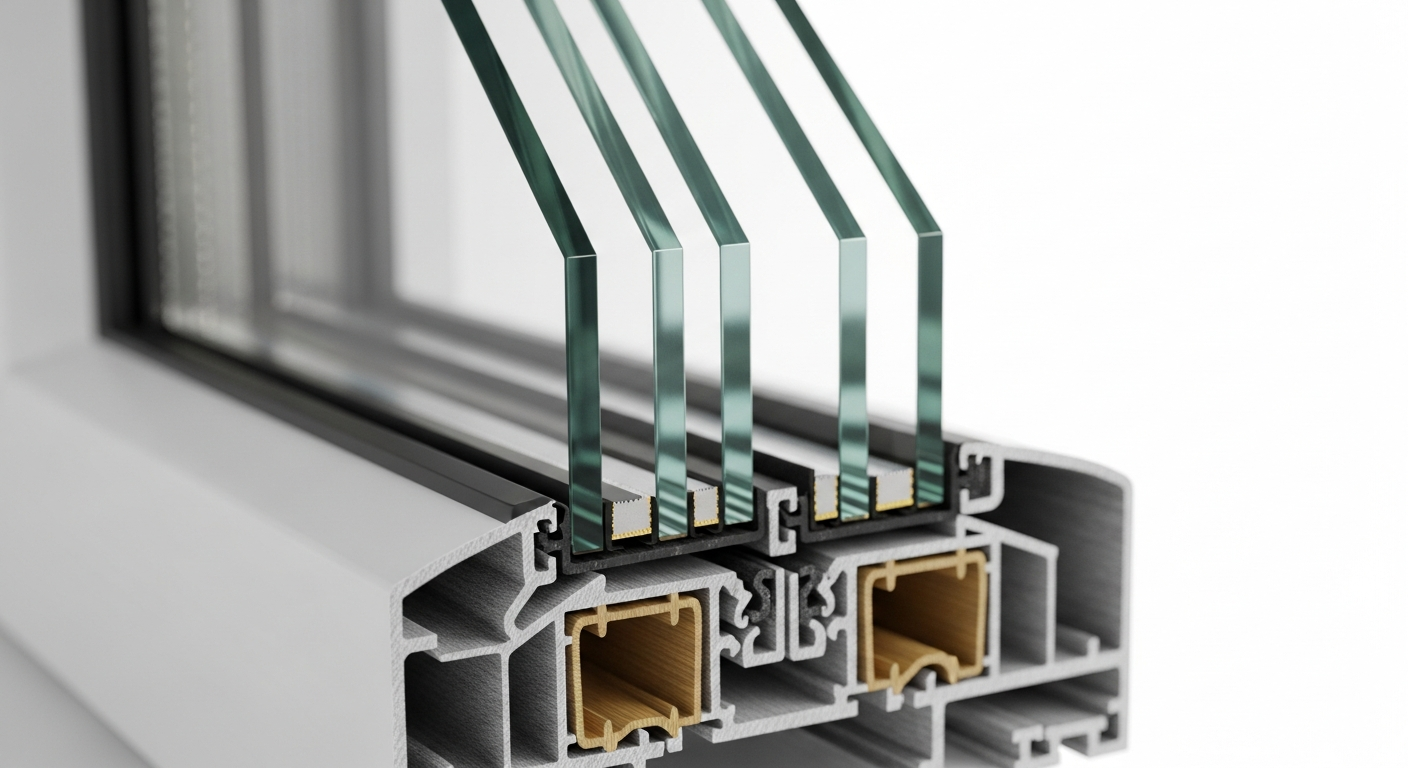
The glass unit itself is a marvel of precision. Modern windows feature multiple panes of glass (double or triple glazing), separated by inert gas-filled cavities (typically argon or krypton) and warm edge spacer bars. Precision is critical in:
- Glass Cutting and Sealing: Exact dimensions and hermetic seals are essential to prevent gas leakage and maintain the integrity of the insulated glass unit (IGU). Even a tiny imperfection can compromise thermal performance.
- Gas Filling: The precise measurement and injection of inert gases between panes replace air, significantly reducing heat transfer by convection. This requires sophisticated machinery and meticulous calibration.
- Spacer Bar Integration: Warm edge spacer bars, made from low-conductive materials, reduce heat transfer at the edge of the glass unit. Their accurate placement and sealing are crucial to avoid thermal bridging around the perimeter of the glass.
Frame Integrity and Uf Value Optimization
The frame is equally important in the pursuit of low Uw values. Precision manufacturing ensures:
- Profile Extrusion: Window profiles are extruded with multiple internal chambers, trapping air and creating an insulating barrier. The accuracy of these profiles, down to fractions of a millimeter, dictates the effectiveness of these chambers and the frame's overall Uf value.
- Material Quality: High-quality PVC or other insulating materials are consistently manufactured to strict specifications, ensuring uniform thermal properties throughout the frame.
- Reinforcement Integration: Precision allows for the seamless integration of steel reinforcements within frame chambers, providing structural integrity without creating new thermal bridges.
Flawless Assembly: Preventing Thermal Bridges
Even the best components will underperform if not assembled with absolute precision. This is where total quality management shines. Every joint, every seal, and every connection must be perfectly aligned and sealed to prevent air infiltration and thermal bridging.
Egelux's Commitment to Superior Thermal Insulation
Egelux exemplifies how a commitment to state-of-the-art manufacturing and total quality management translates directly into superior thermal performance. By utilizing advanced production lines and rigorous quality checks at every stage, Egelux ensures that their double and triple glazing options, available in widths of 24, 30, 36, 44, and 52 mm, consistently achieve their stated U-values.
Their ability to accommodate 44 mm triple glass units with Ug values of 0.6–0.7 W/m²K, combined with frame sections boasting a Uf of 0.95 W/m²K, culminates in an overall window Uw value of 0.78 W/m²K for their Pimapen Prime 80 series. This is a testament to how precision manufacturing techniques lower window Uw values for maximum thermal efficiency, delivering real-world benefits to consumers.
The Long-Term Benefits of Low Uw Windows
Investing in windows manufactured with such precision offers significant long-term advantages:
- Reduced Energy Bills: Lower Uw values mean less heat loss or gain, directly translating into lower heating and cooling costs.
- Enhanced Comfort: Consistent indoor temperatures and reduced drafts create a more comfortable living or working environment.
- Environmental Impact: Decreased energy consumption contributes to a smaller carbon footprint, supporting sustainability efforts.
- Increased Property Value: Energy-efficient windows are a desirable feature, adding value to any property.
Conclusion
The journey to maximum thermal efficiency in windows is paved with precision. From the microscopic layers within the glass to the intricate multi-chambered frame profiles and the meticulous final assembly, every step in the manufacturing process plays a vital role in achieving impressively low Uw values. Companies like Egelux, through their dedication to state-of-the-art manufacturing and total quality management, demonstrate how precision manufacturing techniques lower window Uw values for maximum thermal efficiency, setting new benchmarks for energy-efficient fenestration. Choosing such high-performance windows is not just an upgrade; it's an investment in comfort, savings, and a sustainable future.